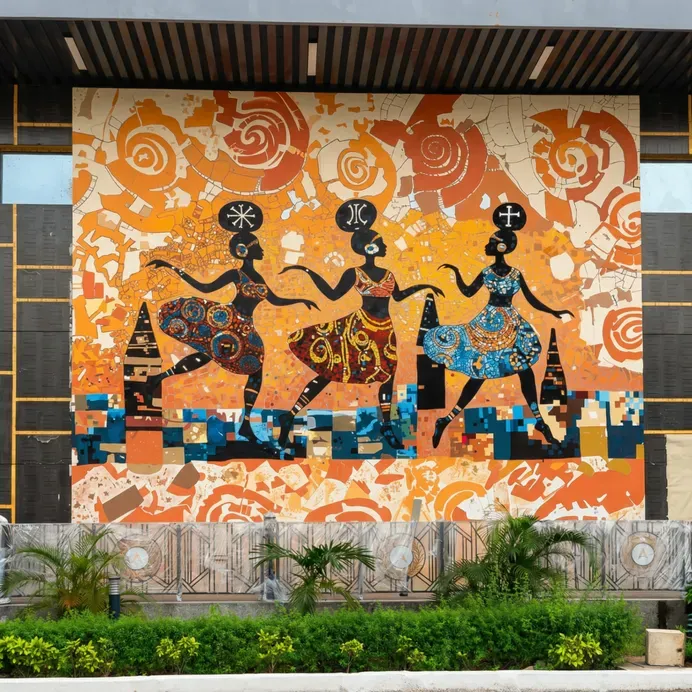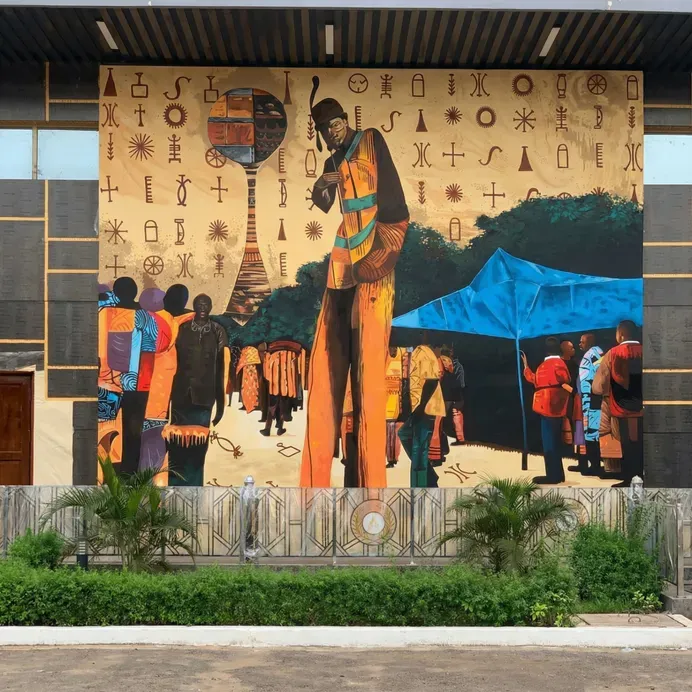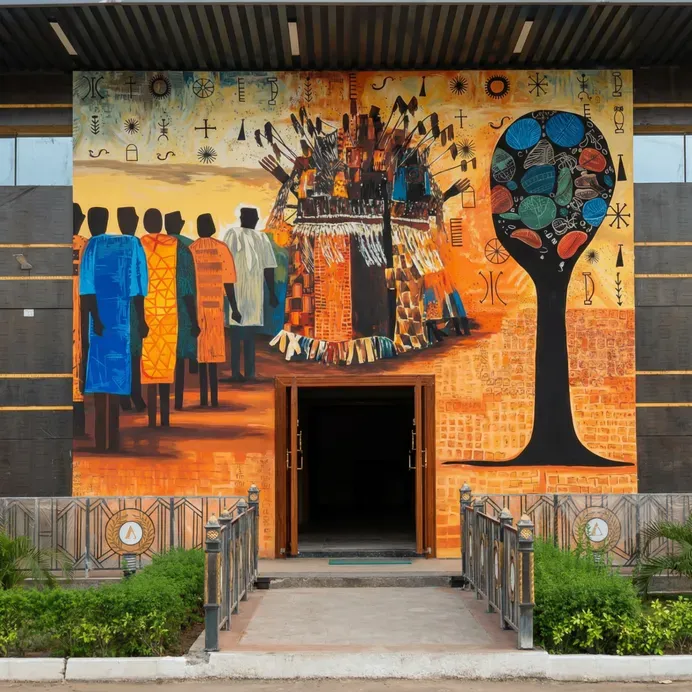
Project Okija is a cultural art programme created for a contemporary resort in Okija, Anambra. Across seventeen hand-painted walls, the project translates heritage into an environment guests can move through—allowing story to unfold through scale, sequence, and architecture rather than remain confined to a single canvas.
The intervention brings together ancestral figures, masquerade traditions, elders, native architecture, Nsibidi symbols, and other visual motifs within one spatial system. Each wall holds an individual narrative, but the wider experience is collective: a contemporary destination authored through the memory of its place.
The brief was not to decorate a resort. It was to make cultural memory part of how the resort is entered, crossed, and remembered.

The Context
A contemporary resort needed a cultural identity rooted in where it stands.
Hospitality environments can be visually complete and still feel detached from place. For Okija, the opportunity was to make the resort recognisable through the cultural intelligence of its setting—not through themed decoration, but through artworks with enough scale and narrative depth to become part of the architecture.
That required a programme capable of holding many stories at once. The art needed to welcome guests who recognised the references, invite curiosity from those encountering them for the first time, and remain coherent across walls with different proportions and roles.
The Cultural Framework
Seventeen walls became chapters within one living archive.
Rather than repeat one motif throughout the property, the programme was developed as a sequence of cultural encounters. Masquerade, kinship, migration, ancestry, work, celebration, and oral wisdom enter the environment through distinct figurative and symbolic compositions.
The walls share a visual rhythm through palette, line, scale, and recurring marks. That common language holds the project together while giving individual works—including The People Moving, Ijele, Umunna Movement, and Izaga—the space to carry their own meanings.


The Spatial Response
Each composition was designed for a wall, a sightline, and a moment of arrival.
The murals are not portable images enlarged after the fact. Their figures, focal points, and fields of detail respond to the dimensions of the surfaces they occupy. Entrances become thresholds into story; long façades carry movement; closer walls reward slower attention.
This architectural approach allows the art to change as guests move. From a distance, colour and large silhouettes establish recognition. At closer range, smaller symbols and relationships emerge, turning circulation through the property into an act of discovery.
The Craft
Hand execution gives the cultural programme its human register.
Working across seventeen walls required continuity of direction and discipline of execution. The hand-painted surfaces preserve variation, gesture, and material presence at a scale that printed graphics cannot reproduce.
That visible authorship matters to the story. A project concerned with memory and collective identity is carried through the trace of making—allowing each surface to feel constructed over time rather than applied as an instant finish.
The Outcome
Guests do not simply view a collection. They enter a cultural environment.
The completed programme gives the resort a sequence of visual landmarks and a point of view that belongs to Okija. The works create recognition across the property while allowing different rooms and approaches to hold distinct emotional tones.
Together, the seventeen murals operate as a living archive: contemporary in expression, architectural in scale, and grounded in the cultural narratives the project was created to carry forward.
Project Okija demonstrates the difference between placing art inside a destination and allowing art to author the destination itself. Here, cultural memory is not a final layer. It is the environment through which the guest moves.