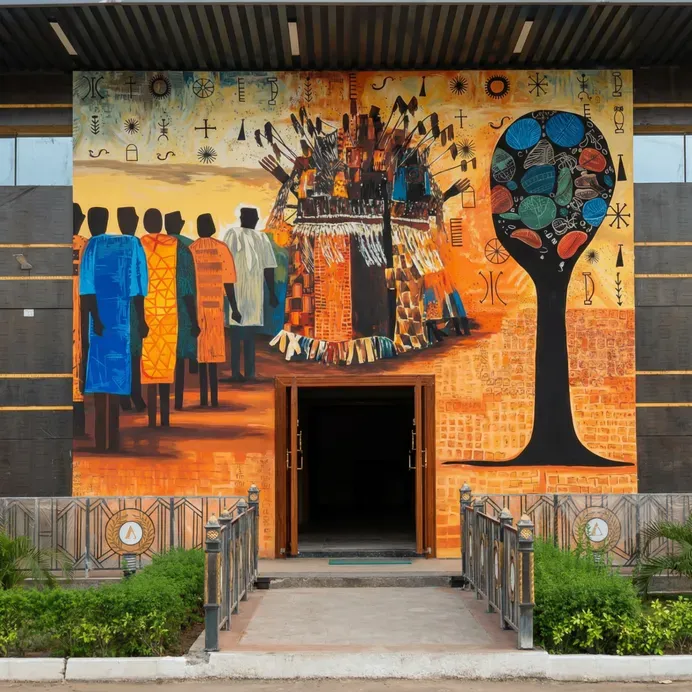
Ijele translates the presence of one of Igbo culture's most revered masquerade traditions into an architectural-scale mural for the Okija resort. The work is conceived around grandeur, layered meaning, and the sense that the figure carries more than spectacle: it arrives with memory, ceremony, and collective recognition.
Within the wider Okija programme, Ijele provides a point of concentrated cultural authority. Its role is to hold attention, deepen the resort's relationship with place, and give the masquerade tradition a contemporary spatial expression.
The challenge was not to reproduce a masquerade as an image. It was to translate its scale, gravity, and cultural presence into architecture.
The Reference
A monumental tradition demands more than surface resemblance.
Ijele is recognised through scale, complexity, and ceremonial significance. The mural draws from those qualities to build an image that can command a large wall without reducing the tradition to a decorative motif.
The work treats heritage as a source of spatial intelligence. Hierarchy, repetition, symbolism, and the relationship between central figure and community all inform how the composition is organised.
The Translation
Masquerade becomes a contemporary visual landmark.
Architectural scale allows the figure to be encountered bodily rather than viewed as a small representation. Guests approach, pass beneath the field of the work, and discover details at different distances.
A contemporary palette and graphic rhythm prevent the mural from becoming a literal reconstruction. The result remains grounded in the reference while speaking confidently within a modern resort.
The Role in Okija
Ijele anchors the cultural authority of the wider series.
Among the many narratives carried across Project Okija, Ijele creates a moment of ceremony and pause. Its concentrated presence gives the wider journey a visual and emotional landmark.
The mural helps the resort communicate that heritage is not being borrowed for atmosphere. It is being treated as a serious source of identity, scale, and meaning.
Ijele brings ceremonial magnitude into the contemporary built environment—allowing a revered Igbo tradition to remain recognisable while taking on a new architectural life.
