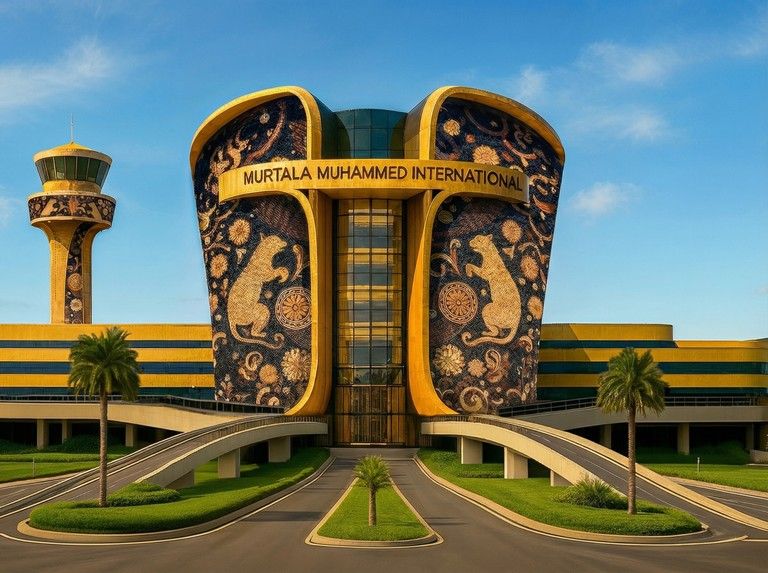
The MMA International Airport concept asks what a national gateway could communicate before a traveller crosses its doors. Rather than treating the terminal as neutral infrastructure, the proposal imagines architecture, public art, and cultural symbolism operating together as an expression of Nigerian ambition.
The work is part of a wider position on African civic design: public infrastructure should not need to borrow its identity from elsewhere. It can be technologically progressive, operationally serious, and culturally authored at the same time.
An international airport is more than a point of transit. It is the first public statement a nation makes to the arriving world.
The Opportunity
Turn arrival into an encounter with national identity.
Airports operate at unusual scale. They process movement, security, orientation, and waiting, but they also carry symbolic weight. For visitors, the terminal becomes an introduction; for citizens, it can become a visible expression of confidence and collective imagination.
The concept therefore begins with identity at architectural scale—not as signage added after the building is resolved, but as a recognisable language embedded into the gateway itself.
The Concept
A monumental façade becomes a contemporary cultural threshold.
The visualisation frames the terminal entrance with a sculptural, shield-like form covered in gold-on-dark pattern. The gesture is legible from a distance, creates a ceremonial centre for arrival, and gives the otherwise functional building a distinct silhouette.
Cultural references are treated as design intelligence rather than surface ornament. Pattern, symmetry, scale, and material contrast give the proposal both civic gravity and a future-facing character.
The Master-Plan Logic
Art should organise the wider passenger experience.
Beyond one façade, the proposal establishes a direction for an art master plan: significant thresholds, circulation zones, waiting areas, and public approaches can each carry a defined role within the cultural story of the airport.
The objective is coherence rather than saturation. Monumental interventions create orientation and memory; quieter works can introduce regional narratives and human scale without competing with the operational clarity the terminal requires.
The Vision
Infrastructure can become a living monument to African design confidence.
This is a concept proposal, not a record of a completed terminal transformation. Its purpose is to make a possibility visible: that Nigeria's busiest airport could function as both global infrastructure and an authored cultural landmark.
The wider ambition is an Africa recognised not only for what it exports, but for the ideas, symbols, and civic environments it creates for itself.
The MMA International Airport concept positions cultural authorship as part of nation-building—using the scale of infrastructure to turn arrival, identity, and public imagination into one experience.
