House of Eweka Pilot, Isle Crescendo
    REAL ESTATE

    House of Eweka Pilot, Isle Crescendo

    High-Performance Real Estate, Built on Culture-Tech

    About the Project

    Isle Crescendo was developed as a pilot for the House of Eweka model: a residential environment in which cultural authorship begins with the architecture rather than arriving after it. Massing, circulation, landscape, art, and atmosphere are considered as one system from the earliest stages.

    The project tests a simple proposition. When identity is structured into a development—rather than reduced to finishes and décor—the property can acquire a clearer point of view, a stronger relationship with place, and a form of distinction that is more difficult to reproduce.

    Culture here is not applied to the architecture. It is organised through it.
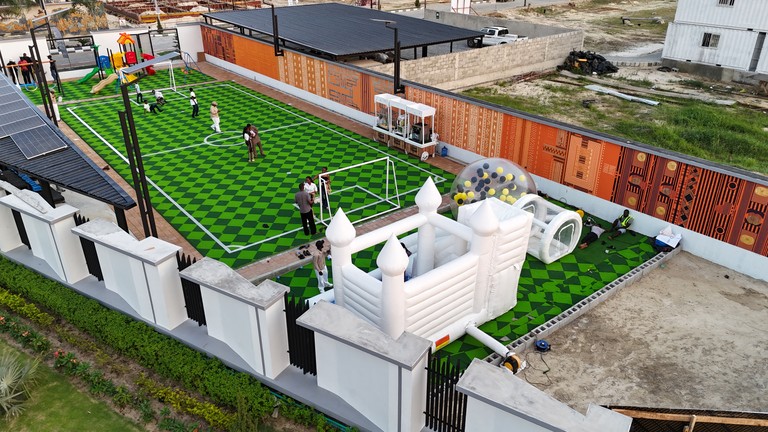
    Aerial project visualisation of Isle Crescendo and its central landscaped court
    The pilot is conceived as a complete residential system in which landscape, circulation, and art share one design logic.

    The Challenge

    Move beyond an interchangeable model of premium real estate.

    Many high-value developments compete through the same signals: imported finishes, familiar amenities, and broadly similar visual references. The quality may be high, but the identity can remain generic. Once that happens, the asset is easier to compare and harder to remember.

    Isle Crescendo was conceived to resist that interchangeability. The pilot treats cultural clarity and spatial authorship as performance criteria alongside material quality—giving the development a recognisable character from its shared spaces to its architectural surfaces.

    The Model

    Architecture and integrated art were developed as one stack.

    The House of Eweka approach begins before walls are treated as empty surfaces. Art direction informs sightlines, thresholds, gathering spaces, and the emotional sequence of the property. Architecture, in turn, gives each work a defined role rather than leaving it to compete for attention after construction.

    This integration produces a more coherent environment. Large mural fields carry identity across long elevations; quieter moments allow material and landscape to lead; movement between them creates rhythm rather than constant visual intensity.

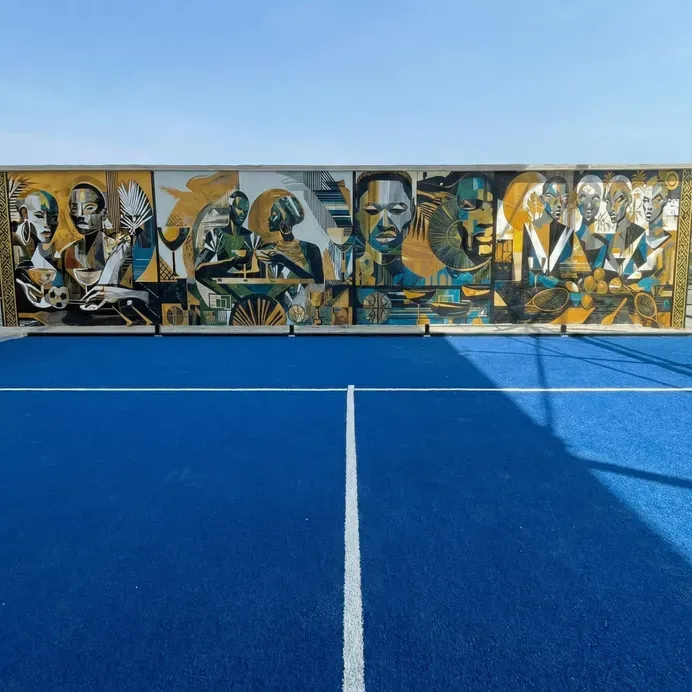
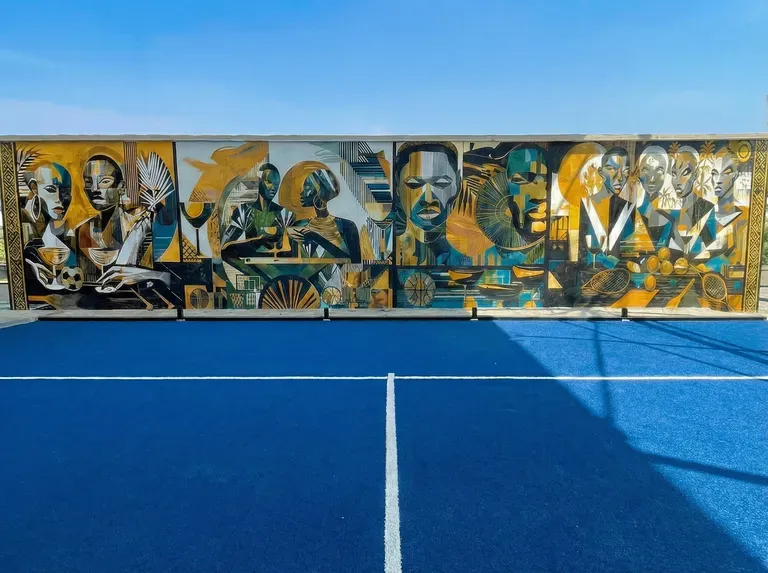
    Long figurative mural running beside a blue court at Isle Crescendo
    A continuous mural turns the edge of a recreational court into a culturally authored elevation.

    The Art Programme

    A family of works gives the development several emotional registers.

    The Crescendo series includes Isola, Abyssa, Bazara, Ashokya, and Agora. Their scales and themes differ, allowing one development to move between expansive storytelling, intimacy, exchange, blessing, and collective gathering without losing its overall coherence.

    Together, the works function as more than a set of feature walls. They give individual areas names, narratives, and points of recognition—helping residents and visitors form a mental map of the environment through culture.

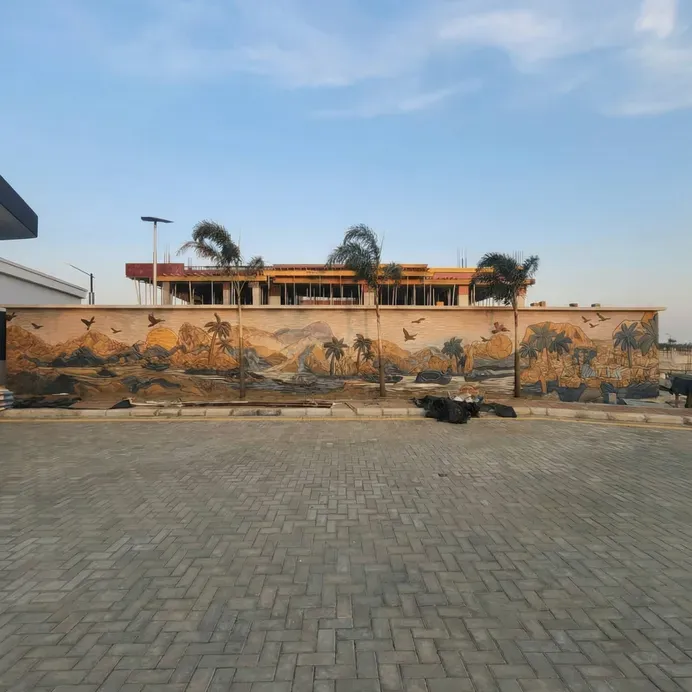
    Extended mural integrated along the outer architecture of Isle Crescendo
    At development scale, artwork behaves as a cultural skin rather than an interior accessory.

    The Long View

    Authorship becomes part of the asset.

    The objective of the pilot was not novelty for its own sake. It was to demonstrate how cultural specificity can support recognisability, emotional depth, and long-term differentiation in residential development.

    By establishing identity at inception, Isle Crescendo avoids relying on surface styling to create character later. The property is conceived as an authored whole—one in which art and architecture preserve their value by continuing to make the environment unmistakably its own.

    Isle Crescendo positions culture-tech as a real-estate discipline: a way to organise identity through the full architectural system and turn a well-finished property into a recognisable, culturally authored asset.

    Services

    • Culturally Authored Design
    • Integrated Art Direction
    • Design Development

    Year

    2025

    Industries

    ArchitectureResidential