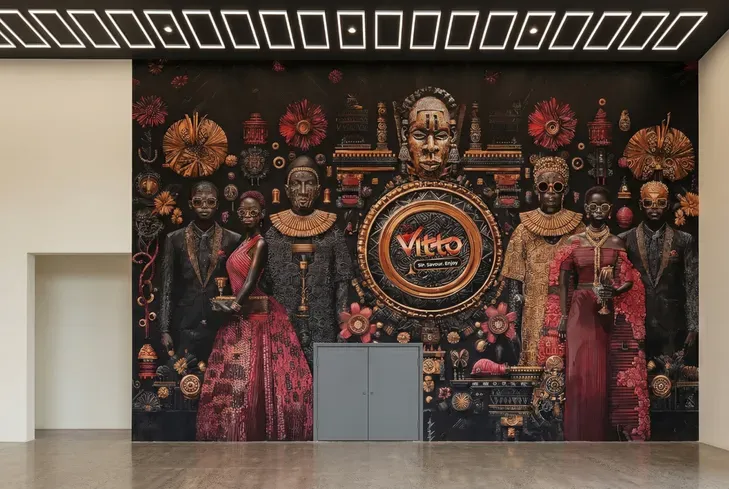
Crimmy Benin is an extra-large cultural mural grounded in the artistic heritage of the Benin Kingdom. The work draws from bronze-casting traditions, royal iconography, courtly presence, and the visual authority through which Benin history has long been recorded and transmitted.
Installed at architectural scale, the mural does not attempt to imitate a museum display. It brings those references into a contemporary environment, creating a public-facing image in which history is encountered as living visual power.
The mural treats Benin heritage not as a decorative source, but as a language of authority, memory, and cultural continuity.
The Heritage
Royal image and bronze tradition establish the cultural centre.
Benin art is recognised for its capacity to hold history through material, hierarchy, and symbol. Crimmy Benin draws from that legacy by organising the composition around figures and emblems with ceremonial presence.
The references are translated through mural scale and contemporary colour, allowing the work to remain connected to its source without presenting itself as a reproduction of historical objects.
The Composition
A courtly assembly becomes an architectural field.
The mural gathers multiple figures across a wide wall, using symmetry, repetition, and a central axis to create a sense of procession and authority. Dark grounds intensify the reds, bronze tones, and patterned details held across the surface.
At distance, the group reads as one ceremonial presence. Closer viewing reveals individual clothing, objects, and expressions, allowing the wider historical world to emerge gradually.
The Cultural Role
A contemporary setting becomes a site of historical recognition.
By giving Benin visual heritage architectural scale, the work creates a landmark capable of holding both pride and reflection. It invites viewers to recognise the depth of the kingdom's artistic language within the present.
The mural therefore operates as more than atmosphere. It gives the setting a named cultural position and makes historical memory part of how the space is experienced.
Crimmy Benin carries royal image, bronze memory, and contemporary mural practice into one cultural landmark—allowing the authority of Benin's artistic heritage to remain visible at architectural scale.
