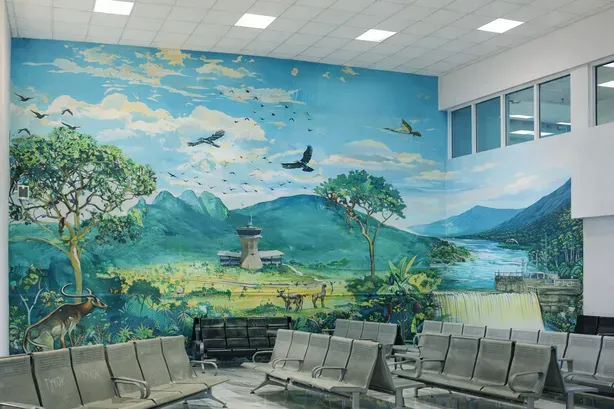
The Taraba Airport mural transforms a seven-point-three by two-point-eight-metre terminal wall into a panoramic introduction to place. Designed for a space defined by arrival and departure, the work brings landscape, movement, and regional identity into the traveller's first encounter with the airport.
Public infrastructure is often treated as culturally neutral. This project takes the opposite position: a terminal can support orientation and function while also giving travellers a clear sense of the land and imagination they are entering.
At an airport, a mural can become both welcome and memory—the first image of a place and the last one carried away.
The Public Brief
Give a functional terminal a culturally specific point of arrival.
Airport interiors must remain legible and operational, yet large waiting and circulation walls can feel anonymous. The Taraba commission uses one controlled architectural surface to introduce identity without competing with the movement around it.
Its long proportion allows the work to register from across the terminal and to unfold gradually for passengers seated or walking nearby.
The Landscape
A panoramic scene connects the terminal to the region beyond it.
Mountains, water, birds, open sky, and cultivated terrain create a layered field that draws the eye beyond the enclosed airport. The mural offers a sense of geographic breadth and positions the landscape itself as a source of regional pride.
The composition balances atmosphere with readability. Large natural forms establish the image from distance; smaller scenes give waiting travellers more to discover over time.
The Civic Role
Public art turns transit into cultural recognition.
Because airports serve residents, visitors, workers, and returning travellers, the work belongs to a wider public than a private commission. It must hold meaning across different levels of familiarity with the region.
The mural responds by making place visible through an accessible visual language, giving the terminal a landmark through which Taraba can be recognised and remembered.
The Taraba Airport mural positions public infrastructure as a cultural threshold—using one panoramic wall to connect travel, landscape, and regional identity.
