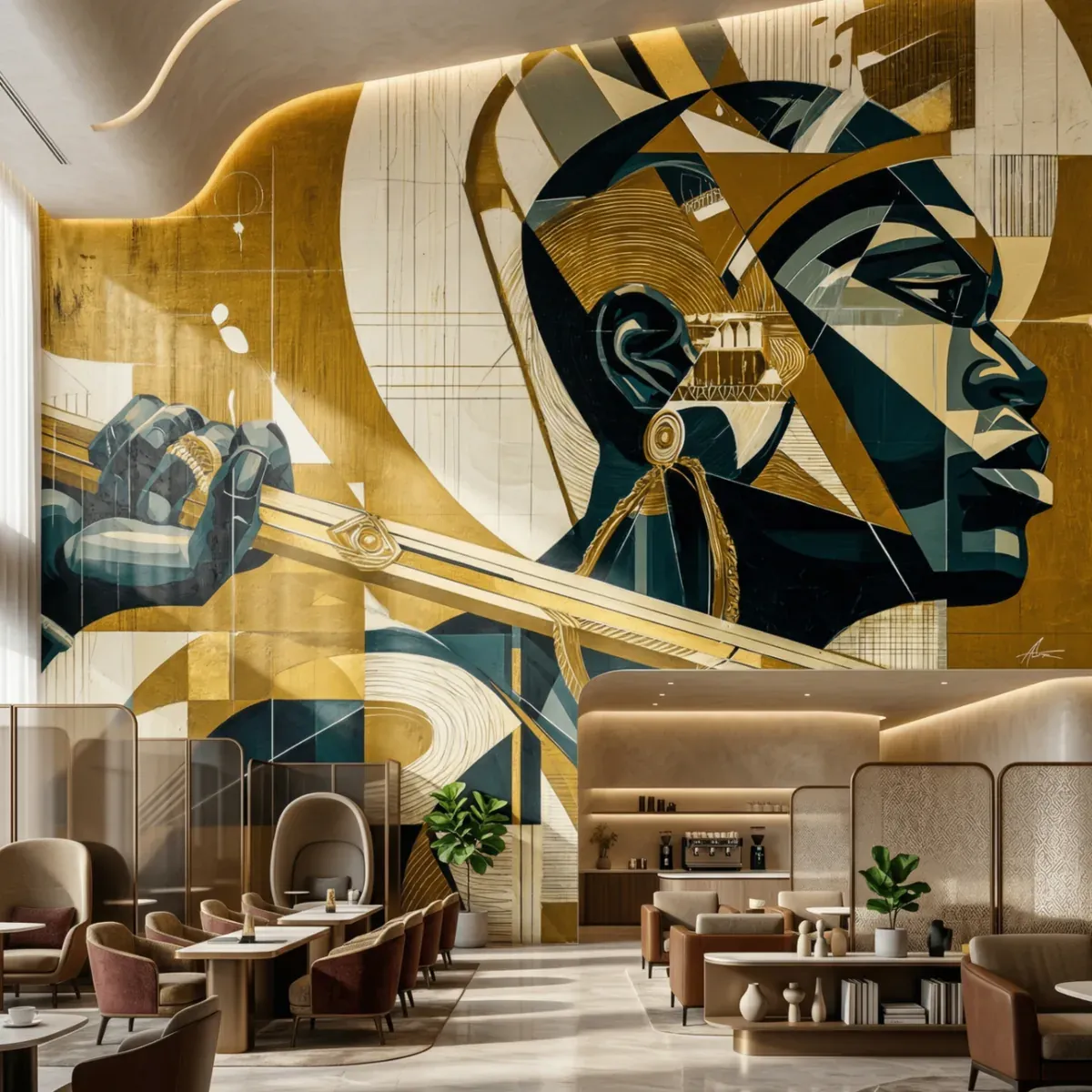
The State of Cultural Intelligence
Why Heritage Is the New Luxury
2026 White Paper · Murals.ng · By Femi Adeleke
"The spaces that win are not the most expensive. They are the most culturally intelligent."
This white paper documents why heritage — encoded into design — has become the defining competitive variable in modern real estate, hospitality, and brand experience. The organisations that ignore this pattern are leaving measurable value on the table. The ones that understand it are building environments that attract, retain, and convert at a level their competitors cannot replicate. This is not a design opinion. This is a business analysis.
01 / The Problem
The Hidden Cost of Generic Space
Across African cities and diaspora markets, buildings are going up faster than ever. Interiors are being fitted out with more budget than before. And yet, the spaces feel borrowed. They look like anywhere. They feel like nowhere.
This is not a budget problem. Developers are spending more. Hotels are hiring interior consultants. Restaurants are flying in European furniture. The money is being spent. The problem is not investment. The problem is intelligence.
Cultural Intelligence (CQ) is the capacity of a space to communicate identity, signal belonging, and generate emotional resonance that translates directly into commercial performance. When CQ is absent, environments default to aesthetic neutrality.
Neutral spaces are commercially expensive. They compete on convenience. They win only on discount.
In Nigerian markets, the highest-value consumer segment is increasingly one that has traveled, compared, and developed a calibrated sense of what authenticity looks like. They have stayed in Bangkok's Rosewood. They have walked through Marrakech's La Mamounia. When they return home and encounter a hotel lobby that looks like it could be in Dubai, Singapore, or New Jersey simultaneously, they do not think premium. They think ordinary.
Ordinary spaces book at ordinary rates. Ordinary restaurants need perpetual promotion. The differentiation that commands a premium — the quality that makes a guest post about a space, return to it, or recommend it — is not found in the specification sheet. It is found in the story the space tells.
02 / What the Data Is Telling Us
Spaces With Cultural Identity Outperform on Every Dimension
Higher Dwell Time. Culturally grounded spaces invite guests to stay longer, return more often, and engage more deeply with the environment. Extended dwell time in hospitality increases ancillary spend per visit.
Organic Content Generation. High-CQ environments produce guest photography and social sharing automatically. A space designed with deliberate visual identity creates what no ad budget can replicate: authentic third-party endorsement at scale. Guests become unpaid distribution channels.
Faster Property Sales. Properties with intentional design narratives close faster and hold higher perceived value at point of sale. Buyers who can see themselves in a space decide faster and negotiate less aggressively.
Stronger Brand Loyalty. Brands that encode African cultural intelligence into their environments report stronger loyalty among the high-value, culturally aware consumer. This segment is growing. Their purchasing power is expanding. And they are actively moving away from spaces that feel borrowed.
03 / Heritage as a Business Asset
Heritage Is a Design Operating System
Pan-African heritage is not nostalgia. It is a deep archive of pattern logic, spatial philosophy, and symbolic grammar accumulated over millennia. The Benin Bronze tradition, the Nsibidi script systems, the spatial logic of the Yoruba compound, the weaving geometries of West African textile arts — these are not historical artefacts. They are living design systems that, when applied intelligently to modern environments, perform commercial functions that imported design languages cannot.
When applied intelligently, heritage performs four functions:
Creates immediate differentiation in markets saturated with Western design vocabulary.
Signals authenticity to a growing class of African consumers actively rejecting performative aesthetics.
Produces visual identities that are genuinely difficult to replicate — they require cultural knowledge, not just execution.
Connects spaces to a narrative that guests, buyers, and clients want to be part of.
Heritage, correctly deployed, is not decoration. It is a competitive moat.
04 / The Cultural Intelligence Framework
Four Dimensions of Cultural Intelligence
01 — Symbolic Literacy. Does the space use a visual language with depth and provenance — or imported symbols with no roots? Symbolic Literacy measures whether the design choices draw from a coherent cultural archive, or whether they are surface-level appropriations of visual motifs without structural understanding.
02 — Emotional Architecture. Does the environment create a feeling on entry? Does it sustain it through the full guest journey? Emotional Architecture examines whether the space has a narrative arc — whether the arrival experience sets a tone that the rest of the space develops and resolves.
03 — Social Transferability. Is the space shareable? Does it produce moments that guests photograph, post, and narrate to others? Social Transferability is the degree to which a space generates organic content and word-of-mouth distribution without paid media support.
04 — Commercial Integration. Is design embedded in business strategy from the start — or applied at the end as a cosmetic layer? Commercial Integration measures whether the design decisions serve the commercial model of the business, or whether they exist independently of it.
A space that scores high on all four dimensions has Cultural Intelligence: the capacity to attract, retain, convert, and amplify without requiring the business to compensate through promotions, discounts, or heavy advertising spend.
05 / Case Study
House of Eweka — Isle Crescendo
"Design was not the last decision. It was the strategic foundation."
The Crescendo deployed cultural authorship as its core architectural strategy from inception — built as a full-stack design system where identity informed every layer of the development, from massing to material language. Rather than commissioning art for finished interiors, the narrative framework was established before the architectural specifications were finalized.
Result: a residential asset with strong visual distinction, clear market positioning, and long-term value performance — avoiding the commoditisation typical of interchangeable luxury developments in the Nigerian market.
We do not add art to buildings. We build the narrative the building serves.
06 / The Opportunity Cost of Inaction
Every Month of Low CQ Is a Month of Compounding Loss
Competing on Price. When design fails to differentiate, the only lever left is price. Discount dependency becomes the default — and a race no independently-run business can sustainably win.
Missing Organic Content. Low-CQ environments produce no shareable moments. No guest photography, no organic circulation, no free visibility. Higher ad spend required just to maintain awareness.
Losing the Culturally Aware Consumer. The fastest-growing, highest-value segment in African markets actively rejects generic environments. They choose spaces with identity. This is not a future trend. It is the operating reality of 2026.
Eroding Brand Equity. Brand equity is built through distinctiveness and memory. Generic spaces build neither. Over time, the business loses the ability to command premium pricing.
07 / What Murals.ng Does
We Build Cultural Intelligence Into Physical Environments
Murals.ng is a culture technology company that builds Cultural Intelligence into physical environments. Our work sits at the intersection of three disciplines:
Cultural Research. Deep study of pattern logic, symbolic grammar, and Pan-African visual systems — applied specifically to your market, audience, and spatial context.
Commercial Strategy. Design as a business lever, not decoration. Every recommendation is tied to a commercial outcome: occupancy, perceived value, shareability, or loyalty.
Execution Craft. Bespoke art installations, spatial experience systems, and mural design — delivered to specification, on time, with integrity.
Our Engagement Ladder
Free Cultural Signal Score — Diagnose the space. Identify the gap.
Design Consultation (NGN 450k remote / NGN 1.2m on-site) — Qualify the opportunity.
Revenue Environment Blueprint (from NGN 3m) — Define the commercial design direction.
Design and Installation (from NGN 8m) — Deliver the built environment.
Quarterly Environment Optimisation (from NGN 3m/quarter) — Keep the space commercially alive.
Conclusion — Heritage Is the New Luxury
The businesses that build Cultural Intelligence into their environments now will hold a compounding advantage over those who continue treating design as decoration.
The organisations that will define African luxury in the next decade are not the ones spending the most on imported materials. They are the ones that understand their market deeply enough to create spaces that feel precisely, unmistakably right for the people they serve.
The category is forming. The decision to invest in Cultural Intelligence now is a decision to enter a compounding advantage loop before it closes.
Unlock the Intelligence Briefing
Reserved for the Custodian Circle.
Enter your details to receive the full 2026 Cultural Intelligence Dossier.