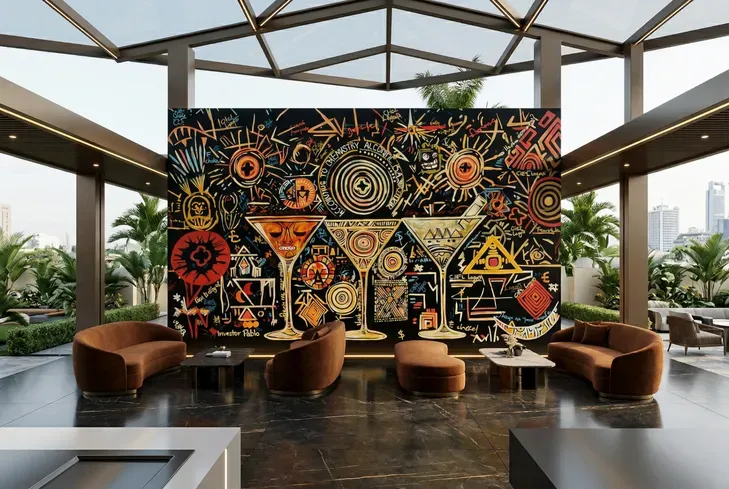
CIEL developed into a layered art programme for a commercial hospitality environment. The project archive moves through rooftop, lounge, corridor, and intimate interior moments, showing how several distinct artworks can create one coherent sense of place without becoming repetitive.
At its centre is a large-scale mural measuring six by 4.2 metres, but the wider intervention extends beyond one feature wall. Figurative scenes, celestial imagery, graphic exterior work, and framed pieces establish different emotional registers across the guest journey.
A complete art programme does not repeat one image everywhere. It gives each zone its own expression within a shared world.

The Brief
Create wonder across spaces with different functions and moods.
The challenge was not simply scale. Each part of CIEL is experienced differently: an exterior surface must register quickly and from distance, a lounge must hold atmosphere over time, and a corridor must sustain movement without feeling visually empty.
The art direction therefore needed enough consistency to connect these zones and enough flexibility to respond to their architecture. Celestial references, human movement, line, and saturated fields of colour became the shared vocabulary.

The Interior Programme
Figurative work gives the social spaces rhythm and presence.
Across the lounge, elongated figures create a sense of movement that mirrors the energy of the room. The composition stretches through the architecture, using repetition and variation to remain active across a long wall rather than concentrating all attention in one central image.
At closer range, gestures and individual forms become more visible. The work can therefore operate as atmosphere for the room as a whole and as a sequence of smaller encounters for guests seated nearby.

The Transitions
Corridors and quieter rooms continue the story at a different volume.
A celestial corridor treatment changes the pace of the programme. Deep colour and suspended forms draw the eye through a transitional space, turning movement between rooms into part of the visual experience.
Framed works carry the same authored quality into more intimate settings. Their smaller scale creates moments of pause and demonstrates that continuity does not require every intervention to be monumental.


The Outcome
One destination, several visual registers.
CIEL now carries a sequence of recognisable art moments rather than relying on a single feature wall to define the entire experience. Each zone can hold its own identity while remaining connected to the wider cultural and celestial direction.
The programme gives guests more to discover, photograph, and remember, and gives the environment a depth that cannot be achieved through decorative repetition alone.

CIEL demonstrates how a commercial destination can use art as a connected spatial system—changing tone from room to room while preserving one clear point of view.
